After US and Israeli strikes on Iran this weekend, followed by retaliatory attacks from Iran across the region, near‑term gas markets have reacted sharply. Front‑month TTF gas futures are up around 40–50% today, currently trading near €46/MWh.
The key risk driver is the Strait of Hormuz, which now appears to be effectively closed. LNG tankers are idling on both sides, shutting in LNG exports from Qatar and the United Arab Emirates. Together, these countries account for roughly 20% of global LNG production. While around two‑thirds of these volumes typically flow to Asia, LNG is a global commodity, meaning the price impact is being felt worldwide. Several European countries, notably Italy, also regularly receive Qatari cargoes.
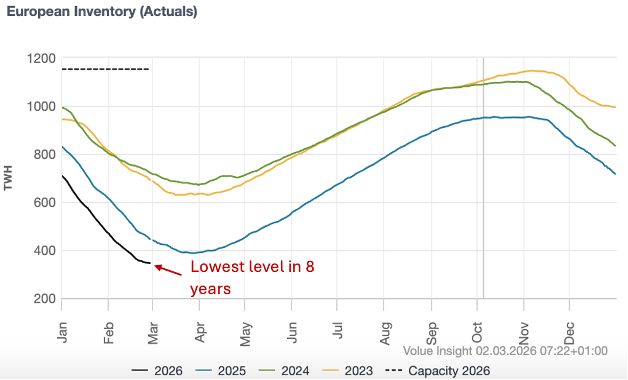
This shock comes at a particularly vulnerable moment for Europe. A cold winter has drawn gas storage levels down to their lowest point in eight years, increasing reliance on strong LNG inflows to refill inventories ahead of next winter. A prolonged disruption of Hormuz—lasting months rather than days—would be highly detrimental and justifies the sharp repricing we are seeing across much of the injection season. A longer‑lasting closure would imply even more severe impacts.
That said, if Qatari exports resume partially or fully within days or weeks, the underlying fundamental impact would be relatively limited, and prices could retrace quickly from current levels.
This is a moment of heightened uncertainty. Developments in Iran, and their implications for shipping through the Strait of Hormuz, will be watched extremely closely. Duration is everything and ultimately depends on Iran’s willingness or ability to sustain a prolonged disruption of this critical shipping lane.
Analysis: Bjørn Inge Vik, Senior Market Analyst